
BC 2.5
Customs Documents Module Guide
Module Location:
CEISA > Customs Documents > BC 2.5
How to Access
- Log in to the CEISA Kokola application.
- Select the Customs Documents menu.
- Click the BC 2.5 submenu.
Page Display
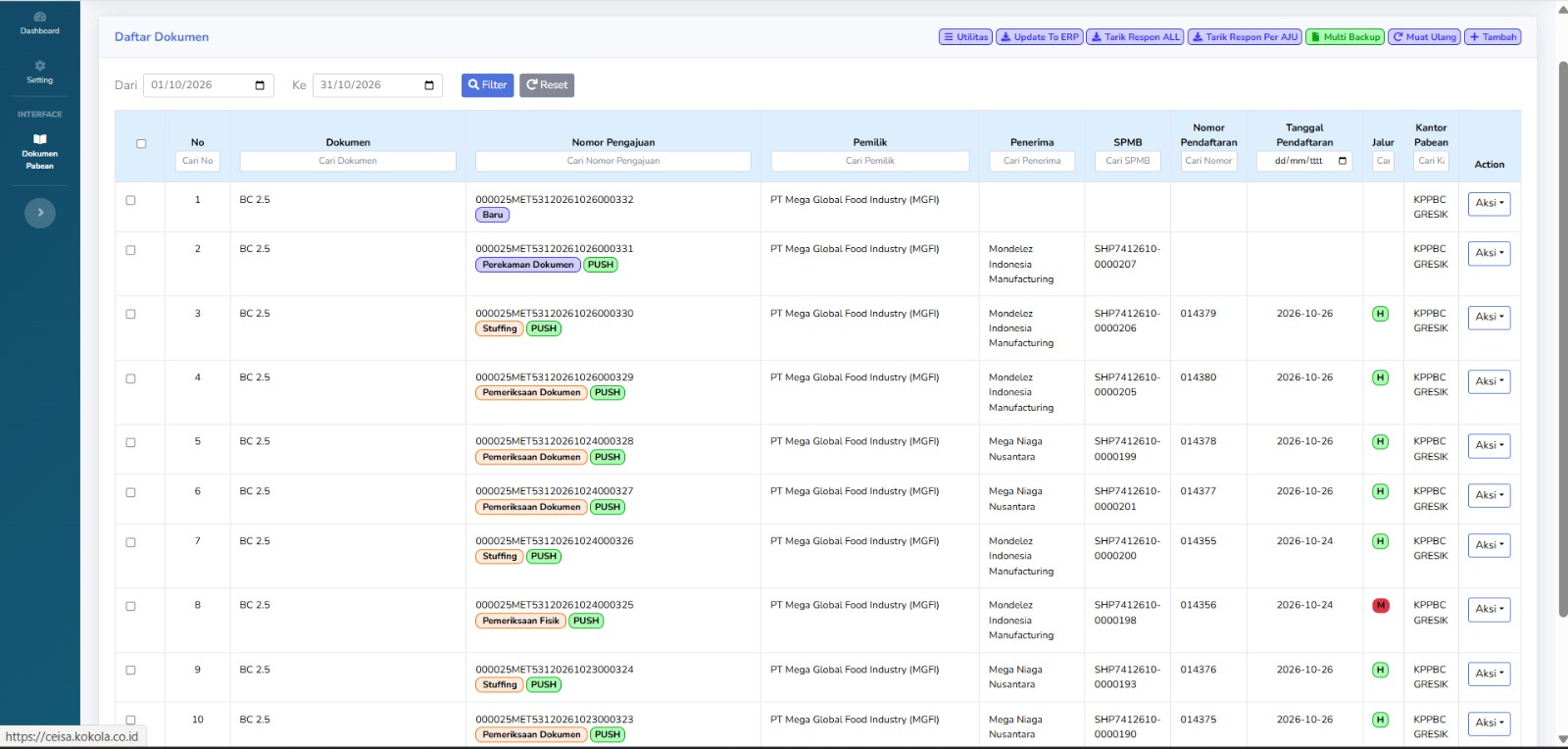
The main page displays a list of BC 2.5 document submissions for goods release activities from the TPB. Each row displays document information, such as submission number, owner, recipient, SPMB, registration number, registration date, route, customs office, and processing status. The page layout consists of a period filter, a document table, a search column, utility buttons, and an action menu.
Column Descriptions
The availableAvailable columns include:
No.:Checkbox: Select one or more documents for actions that support bulk selection.- No: Displays the document’s
serialsequential number in the list. - Document: Displays the type of customs document, namely BC 2.5.
ApplicationSubmission Number: Displays the AJUnumber,numberwhich identifiesas thecustomsdocumentapplication.submission identifier.- Owner: Displays the name of the company or party owning the goods.
- Recipient: Displays the name of the company or party receiving the goods.
- SPMB: Displays the SPMB reference number
associatedrelatedwithto the goods release transaction. The abbreviation and source of this number must be aligned with the Kokola system. - Registration Number: Displays the
documentdocument’s registration numberissued throughfrom the customs process. - Registration Date: Displays the
datedocument’s registration date. - Channel: Displays the
documentindicatorwas registered. Lane: Displaysfor the customs servicelane indicator, such as Green LaneorRedsupervisionLane.channel.- Customs Office: Displays the Customs
officeOffice handling the document. - Action: Displays options for further actions
onregarding theselecteddocument. Additionally, there is a checkbox to select documents and a search field to find specific data.
Button Descriptions
- Filter: Displays documents based on the selected date range.
- Reset: Restores search settings to their default state.
- Utilities: Opens a menu of additional features for document management.
- Update to ERP:
Used to updateUpdates orsynchronizesynchronizes document data with the company’s ERP system. - Retrieve ALL Responses:
Used to retrieveRetrieves orupdateupdates customs responses for a number of documents. - Retrieve Response by AJU:
UsedRetrievestoorretrieveupdates responses based on a specific application number. - Multi Backup:
Used to backBacks up multiple documentsataccordingonce.to the application’s features. - Reload: Refreshes the document list view.
- Add:
UsedOpenstothecreateprocess for creating a new BC 2.5document submission.document. Filter:Actions: Displaysaadditionallistactionsof documents based onfor the selecteddate range.Reset: Resets search settings to their default state.document.
Status and Process Explanation
In the Application Number column, there are several indicators that show the document processing stages:
- New: Indicates that the document is in the initial stage or has just been created.
- Document Entry: Indicates that the document is in the data entry stage.
- Document Review: Indicates the document review or investigation stage.
- Physical Inspection: Indicates the stage related to the physical inspection of goods.
- Stuffing: Indicates the stage of loading or arranging goods into a transport vehicle.
- PUSH: An application indicator believed to be related to the data transmission or synchronization process.
In the Lane column, the following indicators are displayed:
- H (Green): Believed to indicate the Green Lane, which is a service lane that generally does not require routine physical inspection, except under certain conditions.
- M (Red): Believed to indicate the Red Lane, which is a service lane that requires physical inspection in accordance with customs regulations.
Note: Statuses such as New, Stuffing, PUSH, and Document Inspection are labels displayed in the CEISA Kokola application. The technical meaning of each status must be aligned with the processes implemented in the system.
Table Navigation Explanation
At the bottom of the document list, the following navigation features are available:
- Show Entries: Sets the number of documents displayed on each page.
- Previous: Go to the previous page of the list.
- Next: Go to the next page of the list.
- Showing Entries: Displays the number of documents currently shown and the total number of available documents.
- Horizontal Scrollbar: Scroll the table view to see columns that are not visible on the screen.
Explanation of the Document Edit Page
When a user selects the Edit action on a BC 2.5 document, the system displays the document details page.
This page is used to view, complete, and update data regarding the issuance of goods from the TPB.
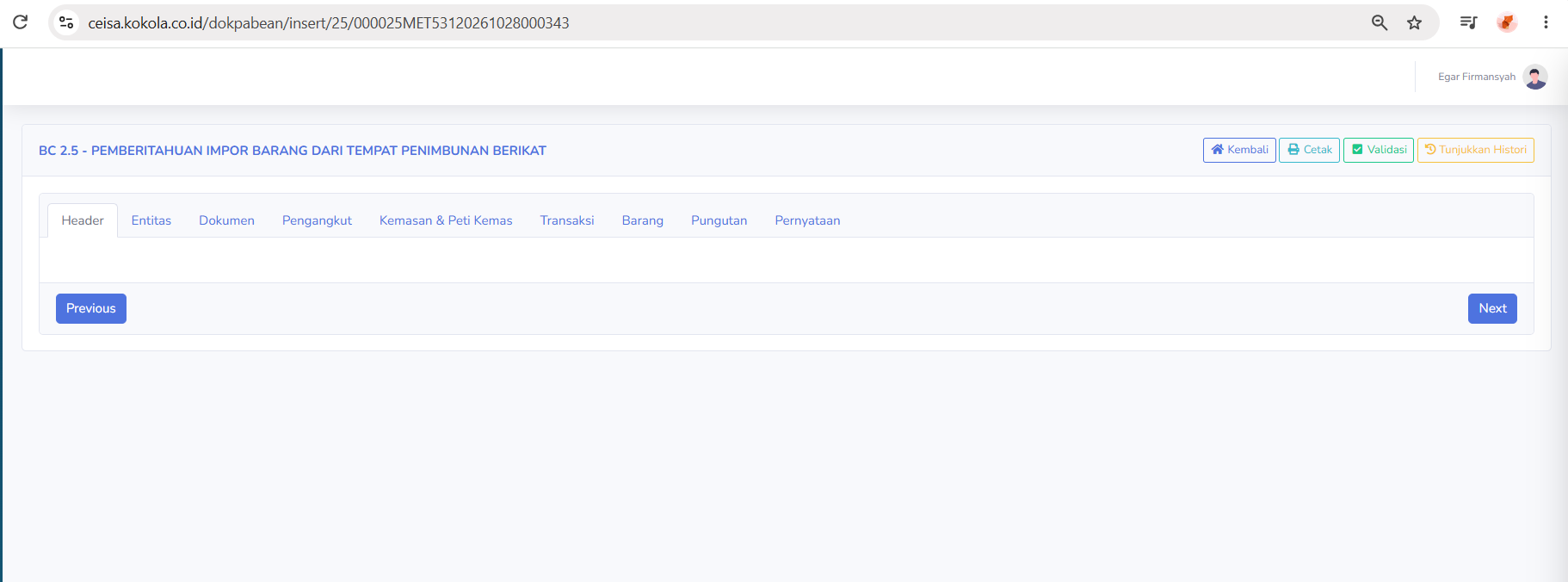
At the top of the page are the following buttons:
- Back: Return to the previous page.
- Print: Prints the document.
- Validate: Runs a check on the completeness and accuracy of the data through the application.
- Show History: Displays the history recorded for the document.
In addition, there are nine navigation tabs: Header, Entity, Document, Carrier, Packaging & Containers, Transaction, Goods, Levies, and Statement.
At the bottom of the page, there are Previous and Next buttons for navigating between tabs.
- Header Tab Description
In the provided screenshot, the header section does not yet display any columns or submission information. What is visible are the navigation menu and document management buttons. Therefore, the details of the header tab cannot be determined from this image.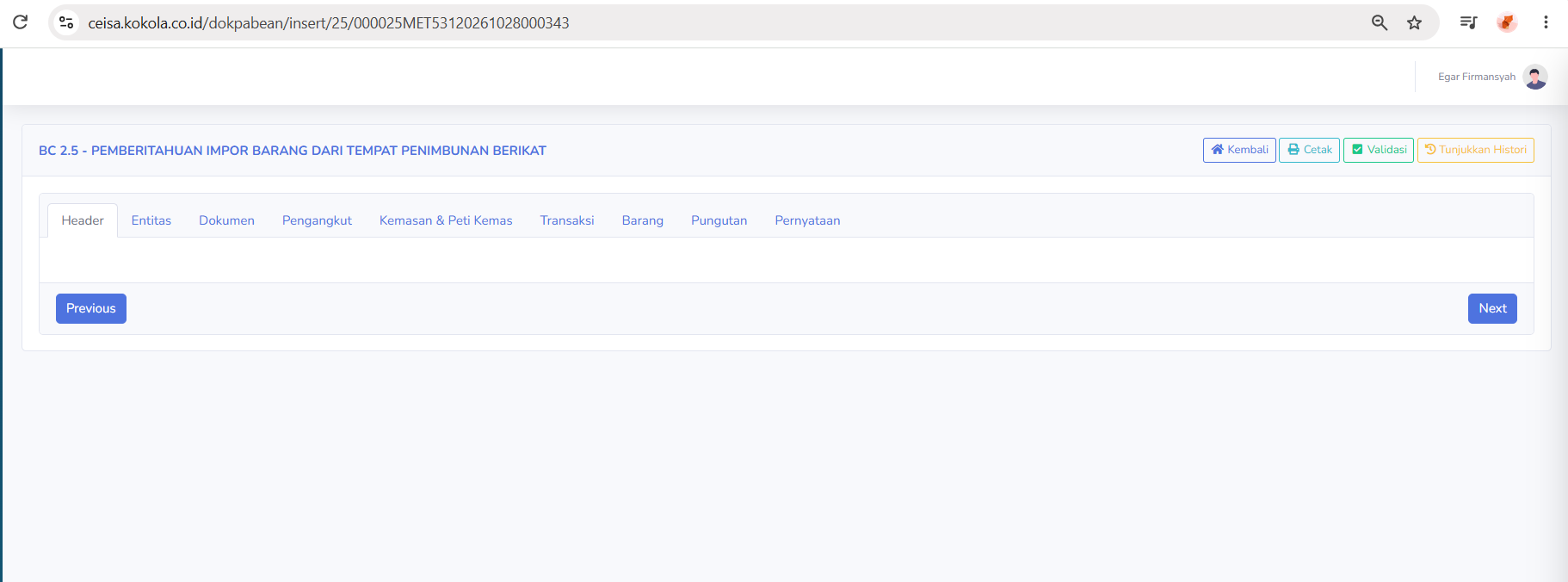
- Entity Tab Description
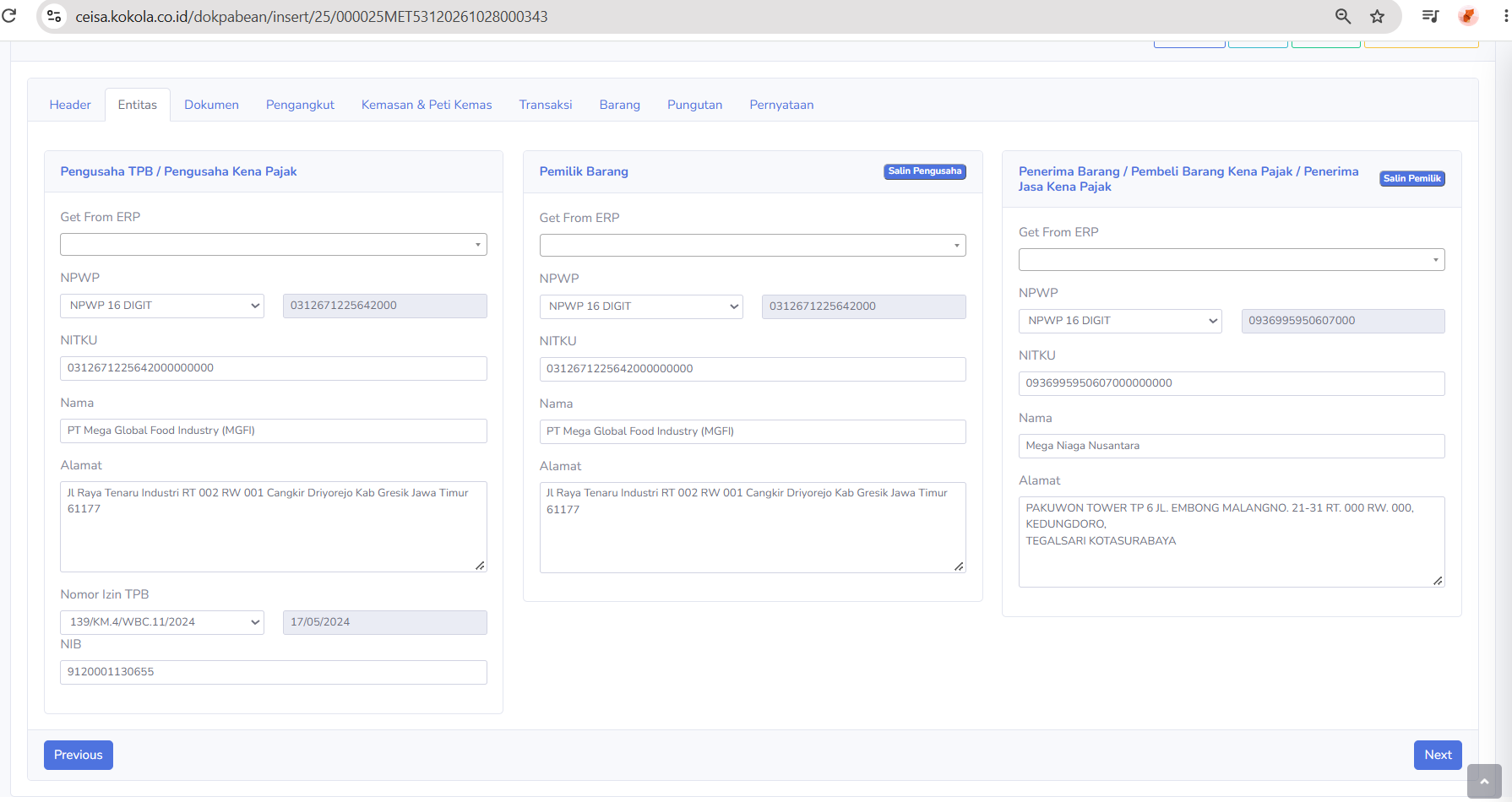
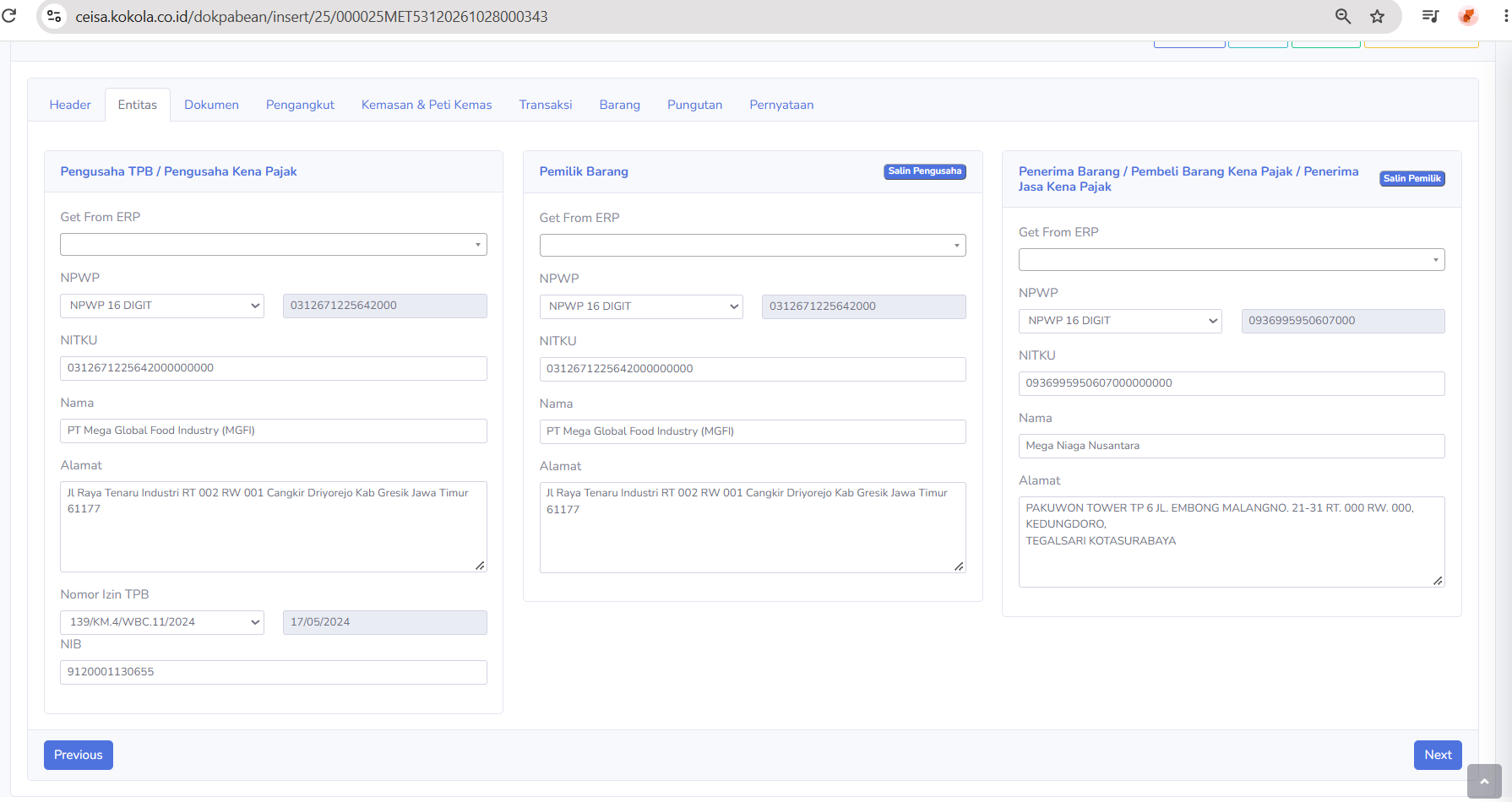
The Entity tab is used to manage the identities of parties involved in the issuance of goods.
There are three main sections.
TPB Business Owner / Taxable Business Owner
-
Get From ERP: Retrieves or selects company data references from the ERP.
-
NPWP: Displays the company’s Taxpayer Identification Number.
-
NITKU: Displays the Business Activity Location Identification Number.
-
Name: Displays the name of the TPB operator.
-
Address: Displays the company’s address.
-
TPB License Number: Displays the TPB facility license number.
-
License Date: Displays the date the license was issued.
-
NIB: Displays the Business Identification Number.
Goods Owner
-
Get From ERP: Retrieves the goods owner's information from the ERP system.
-
NPWP: Displays the goods owner's NPWP
-
NITKU: Displays the business location's identification number.
-
Name: Displays the name of the company that owns the goods
-
Address: Dsiplays the address of the owner of the goods
-
Copy Business Owner: Copies the TPB Business Owner's identity to the Owner of Goods section if both are the same paerty.
Recipient of Goods / Purchaser of Taxable Goods / Recipient of Taxable Services
-
Get From ERP: Retrieves recipient information from the ERP
-
NPWP: Displays the recipient's NPWP
-
NITKU: Displays the recipient's business location ID
-
Name: Displays the recipient company's name
-
Address: Display the recipient's address.
-
Copy Business Owner: Copies the Goods Owner's information to the arecipient section if both parties are the same.
This tab helps ensure that the data for the business owner, owner, and recipient matches the transaction documents.
-
Get From ERP: Retrieves the goods owner's information from the ERP.
-
NPWP: Displays the goods owner's NPWP.
-
NITKU: Displays the business location's identification number.
-
Name: Displays the name of the company that owns the goods
-
Address: Displays the address of the goods owner
-
Copy Business Owner: Copies the TPB business owner's identity to the Goods owner section if both are the same party
Recipient of Goods / Purchaser of Taxable Goods / Recipient of Taxable Services
-
Get From ERP: Retrieves recipient information from the ERP.
-
NPWP: Displays the recipient's NPWP.
-
NITKU: Displays the recipients business Location ID.
-
Name: Displays the recipients company's name
-
Address: Displays the recipients address
-
Copy Business Owner: Copies the Goods Owner's information to the recipient section if both patiesare the same
This tab helps ensure that the data for the business owner, owner, and recipient matches the transaction documents.
-
- Document Tab Description
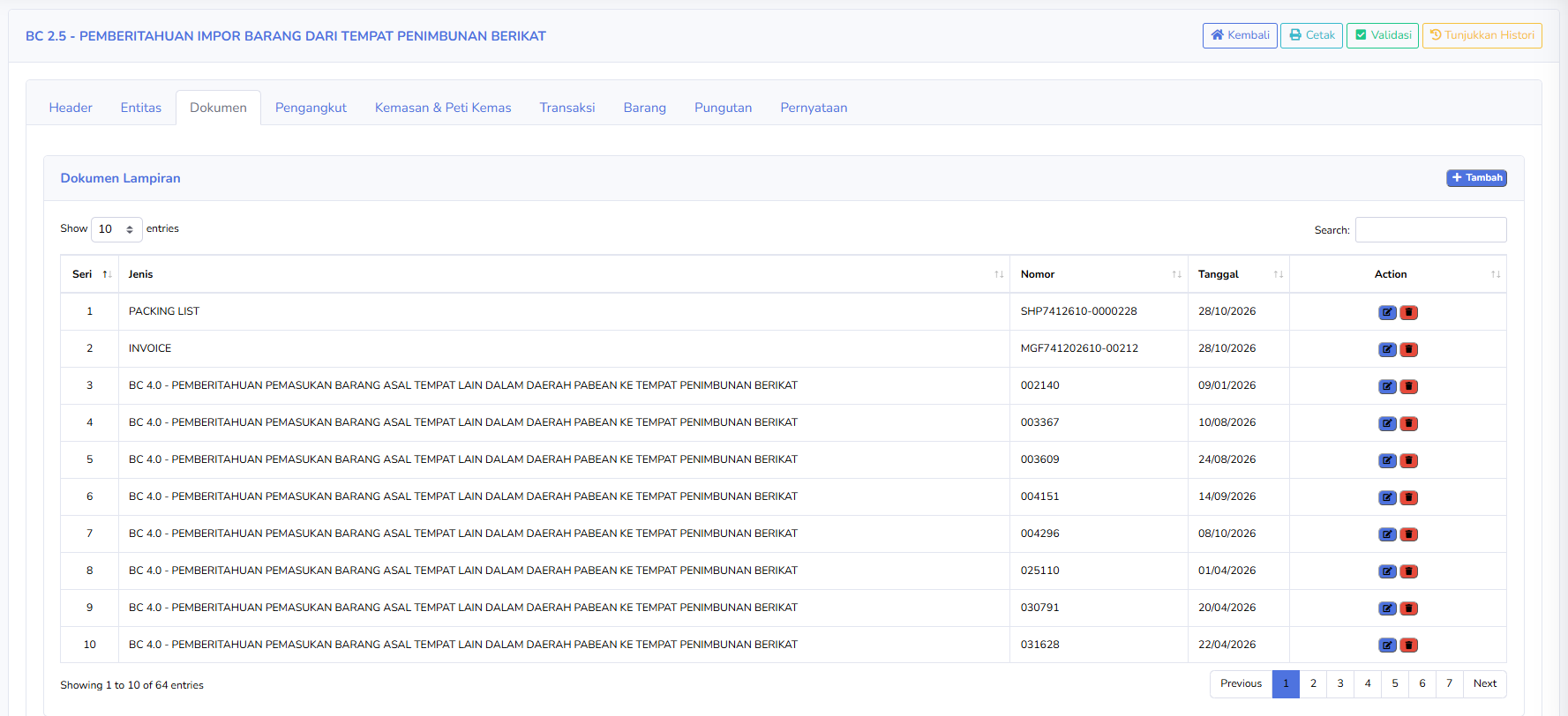
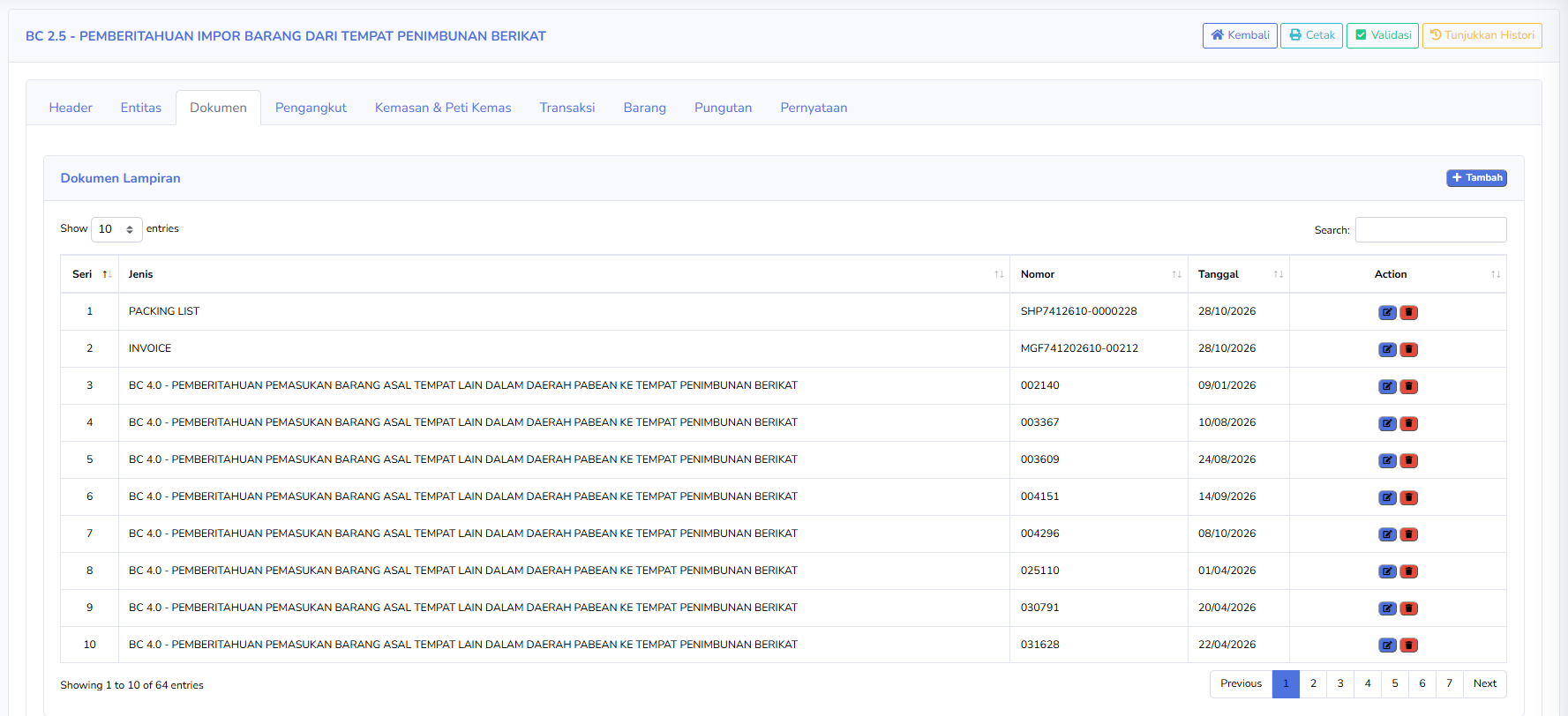
The Documents tab is used to manage the list of supporting documents or reference documents related to the BC 2.5 submission.
Kolom yang tersedia meliputi:
-
Seri: Menampilkan nomor urut dokumen.
-
Jenis: Menampilkan jenis dokumen lampiran.
-
Nomor: Menampilkan nomor identifikasi dokumen.
-
Tanggal: Menampilkan tanggal dokumen.
-
Action: Menampilkan pilihan untuk mengedit atau menghapus data.
Contoh dokumen yang terlihat pada gambar:
-
PACKING LIST: Dokumen yang memuat rincian kemasan dan barang.
-
INVOICE: Dokumen transaksi atau penjualan barang.
-
BC 4.0: Dokumen pemberitahuan pemasukan barang asal TLDDP ke TPB yang digunakan sebagai salah satu referensi.
Tombol yang tersedia:
-
Tambah: Menambahkan dokumen lampiran baru.
-
Edit: Mengubah informasi dokumen lampiran.
-
Delete: Menghapus dokumen lampiran yang dipilih.
-
Search: Mencari dokumen berdasarkan kata kunci.
-
Show Entries: Mengatur jumlah dokumen yang ditampilkan.
-
Previous / Next: Berpindah antarhalaman daftar dokumen lampiran.
Pada screenshot terdapat 64 entri dokumen lampiran, dengan 10 entri ditampilkan pada halaman pertama.
Catatan: Referensi BC 4.0 dapat digunakan untuk menelusuri asal barang dalam transaksi BC 2.5. Namun, referensi setiap dokumen harus dicocokkan dengan barang terkait.
-
- Carrier Tab Description
- Packaging & Container Tab Description
- Transaction Tab Description
- Goods Tab Description
- Levies Tab Description
- Statement Tab Description
Usage Steps
Tips & Important Notes
- Make sure the search period matches the document you wish to check.
- Use the Application Number to facilitate the search for a specific document.
- The Application Number and Registration Number serve different purposes.
- Check the names of the owner and recipient to ensure the transaction is correct.
- Check the document status to determine the stage of the application process.
- Ensure the document meets customs requirements before releasing the goods.
- The Green or Red Lane indicator does not always mean that the goods release process is complete.
- Check the customs response to confirm the document’s processing outcome.
- Use the Action button and ERP synchronization features as needed and in accordance with company procedures.